
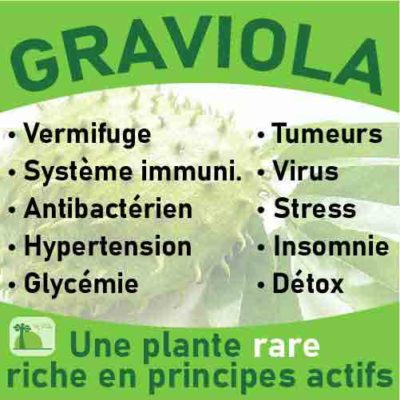
Therapeutic effects of graviola corossol juice:
• Strengthens the immune system
• Prevention of cell aging
• Anti-cancer properties of acetogenin
• Natural antibacterial
• Reduces stress
• Cleanses the body
• Anti-mutagenic (protects healthy cells)
The corossolier (Annona Muricata) is a small tree of the Annancae family which measures less than 7 meters high which grows in the tropical forests of Africa, South America, and Southeast Asia. The French who live in the Antilles, in the Indian Ocean or in the Pacific islands know very well its delicious fruit: graviola corossol.
Horosolier and graviola corossol - Brief botanical description
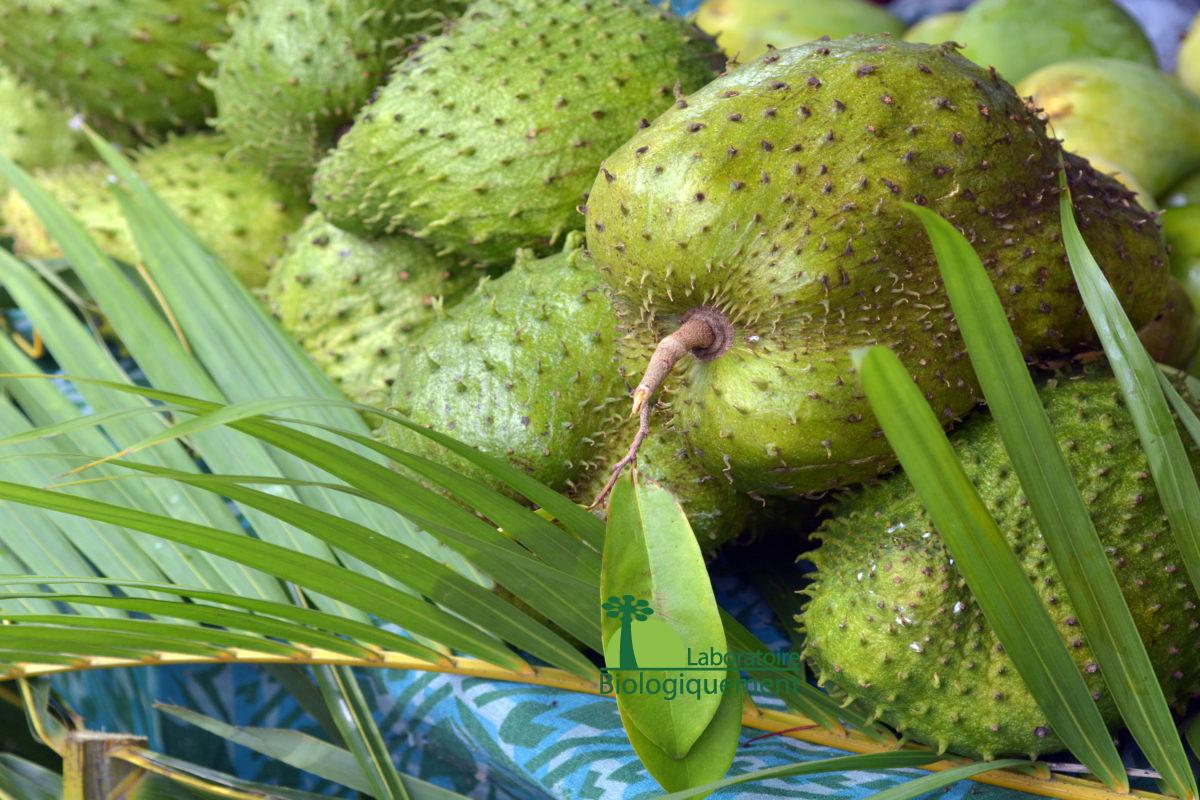
Graviola corossol is a large ovoid green fruit that can measure up to 30 cm long. Covered with small flexible spines, this fruit offers a white, fibrous and luscious edible flesh containing flattened black seeds.
The corossol, called in some countries: Cacching, Graviola, Sapotille, Ango, Soursop (English), or Guanábana (Spanish), is an exotic fruit much appreciated for its pleasant and slightly acid flavor that is used in the manufacture of drinks, ice creams, pies or jams.
The corossol flowers have 6 yellowish green petals. The leaves are smooth, shiny and oblong, measuring 7 to 20 centimeters in length.
GRAVIOAL Corossol - nutritional values for 100 grams of fruit
100 grams of corossol contains the following amounts of nutrients:
► 1 g of protein, 17 g of carbohydrates, 0.3 g of lipids and 81 g of water.
The quantities of vitamins enclosed in 100g of fruit are as follows:
► 20.6 mg of vitamin C, 0.07 mg of vitamin B1, 0.05 mg of vitamin B2, 0.9 mg of vitamin B3, 0.253 mg of vitamin B5, 0.059 mg of vitamin B6 and 2 UI of Provitamin A.
Here are the nutritional values concerning the minerals contained in the corossol:
► 278 mg of potassium, 27 mg of phosphorus, 21 mg of magnesium, 14 mg of calcium, 14 mg of sodium and 0.6 mg of copper.
There are 66 kcal in 100 grams of corossol flesh.
The active ingredients of the corossolier
Studies have highlighted the presence in the corossolier of the following phytochemical compounds: tannins, steroids, alkaloids, phenolic compounds, saponosides, terpenoids, flavonoids, cardiac glycosides.
Among the alkaloids discovered, there is coreximin (respiratory and anti-hypertensive stimulant), stéphanine (sedative properties), atherospermine, reticulin (with antibacterial, analgesic and spasmolytic virtues), anomurine, annomuricin and coclaurine.
• The flesh of the graviola organic corossol is rich in sucrose> (2.53 %), dextrose (5.05 %) and levulose (0.04 %).
• Fruit is an excellent source of fructose and vitamins B (B1 and B2) and C.
• Recent studies have enabled three acetogenins to isolate: Annacin, Annacin-A and Annomuricin-A.
The properties of the corossolier and the organic corossol graviola
Here is a long list of therapeutic properties attributed to all parts of the corossolian fruit tree: antibacterial, anticancer, anticonvulsive, antidepressive, anti-diarrheal, anti-dysentery, anti-inflammatory, antifungal, antineoplasic, antiparasitic (deworming), antispasmodic, antiviral, antiviral, antiviral, antiviral, antiviral, antiviral Astringent, Carminative, Blood Depurative, Febrifuge, hypotensive, insecticide, sedative, sudorific and vasodilator. and anticancer.
The therapeutic virtues of the corossolier - traditional medicine
Medico-traditional uses of the different parts of the corossolier:
• Immature fruits are used to treat dysentery and diarrhea (astringent properties).
• Mûrs corossol fruit juice is used as a diuretic to treat hematuria or uretritis.
• The ripe fruit rich in vitamin C is an excellent antiscorbutic.
• The flesh of the graviola corossol is used as a poultice to remove the Augustats (mites).
• In traditional Indonesian medicine, the horn is used as a remedy for anti-inflammatory and anti-tumor virtues (powerful anti-cancer).
• In the West Indies, the corossolier is used as dewormer.
The therapeutic corosselar benefits - Scientific studies
In 1976, an investigation program in phytotherapy, led by the National Cancer Institute of the United States, discovered that the leaves, stems and the fruit of the corossolier contain cytotoxic agents capable of destroying cancer cells.
Three groups of independent researchers have managed to isolate these compounds separately. These compounds indeed exercise selective toxicity against several types of cancer cells, without damaging healthy cells.
These discoveries were published in eight different clinical studies. Several acetogenins have shown selective toxicity against tumor cells in very low doses, as low as 1 ppm (parts per million). In 1998, four studies were published on the action of acetogenins on lung cancer, breast cancer, pancreatic cancer, liver cancer, prostatic adenocarcinoma, colon adenocarcinoma, breast adenocarcinoma.
• The corossolier can have an antidepressive activity because of its ability to stimulate serotonin receptors in the brain.